 Get in Touch
Get a Quote

You can usually test a fleet dash cam before signing a contract, but how far the test goes depends on the supplier. Expect a live demonstration and a footage request as the minimum, and ask in writing whether a fitted pilot on your own vehicles is available. Nothing should be assumed: trial terms differ between suppliers, so get them confirmed before you commit. If you are still choosing a system, start with this guide on how to choose a fleet dash cam.
- You can usually test a fleet dash cam before signing, but a fitted trial must be agreed in writing.
- Test footage retrieval, camera angles, portal usability and mobile coverage, not just the sales demo.
- Crystal Ball SmartCam 4G uploads footage to the cloud: authorised users retrieve it on demand, and incident recordings upload automatically.
- Never sign until trial, exit and installation terms are written down and match what you tested.
Why testing before you sign matters
A dash cam contract commits you to hardware, installation and usually a service term. A brochure cannot show you whether the footage is clear on your vehicles, whether your team can find an incident quickly or whether the system works on your routes.
A test turns those questions into evidence. It also shows you how the supplier behaves when something needs fixing, which matters more than any feature list once the cameras are fitted.
Fleet managers who skip the test tend to discover problems after installation, when changing course is slow and awkward. Five practical checks in 2026 will catch most of them before you sign.
Can you test a fleet dash cam before signing a contract?
Yes, in most cases you can test some part of the system. The depth of the test is the difference. Use the table below to see what each option proves and what it leaves open.
| Test option | What it proves | What it does not prove |
|---|---|---|
| Supplier demonstration | How the portal looks and works, which functions exist | How footage looks on your vehicles and routes |
| Footage request on a demo account | How quickly and easily you can find and view an incident | Camera positioning in your cab or on your body type |
| Fitted pilot on your own vehicles | Image quality, coverage and daily use in real conditions | Long-term reliability across a whole fleet |
| Written trial and exit terms | Your position if the system does not suit you | Anything about product performance |
The first two options are the easiest to get. A fitted pilot is the strongest test, but it is a commercial decision for the supplier, so ask for it directly and ask what it costs, how long it runs and what happens at the end.
Verdict: a demonstration shows you the product, a pilot shows you whether it works for your fleet, and the written terms show you whether you can walk away.
What to test, step by step
Work through these five steps in order. Each one answers a question a contract will not.
- Demo portal. Ask to see the customer portal used the way your team would use it. Look for how you find a vehicle, a journey and an incident, and how many clicks each takes.
- Pull footage. Ask the supplier to retrieve footage for a specific time and vehicle while you watch. Note how long it takes and how clear the result is.
- Check coverage. Ask how the system behaves where mobile signal is weak, and test on a route you know has poor coverage.
- Check cameras. Confirm which camera views are standard and which are optional, then check the angles on a real vehicle.
- Review contract. Compare what you tested with what the contract describes, line by line.
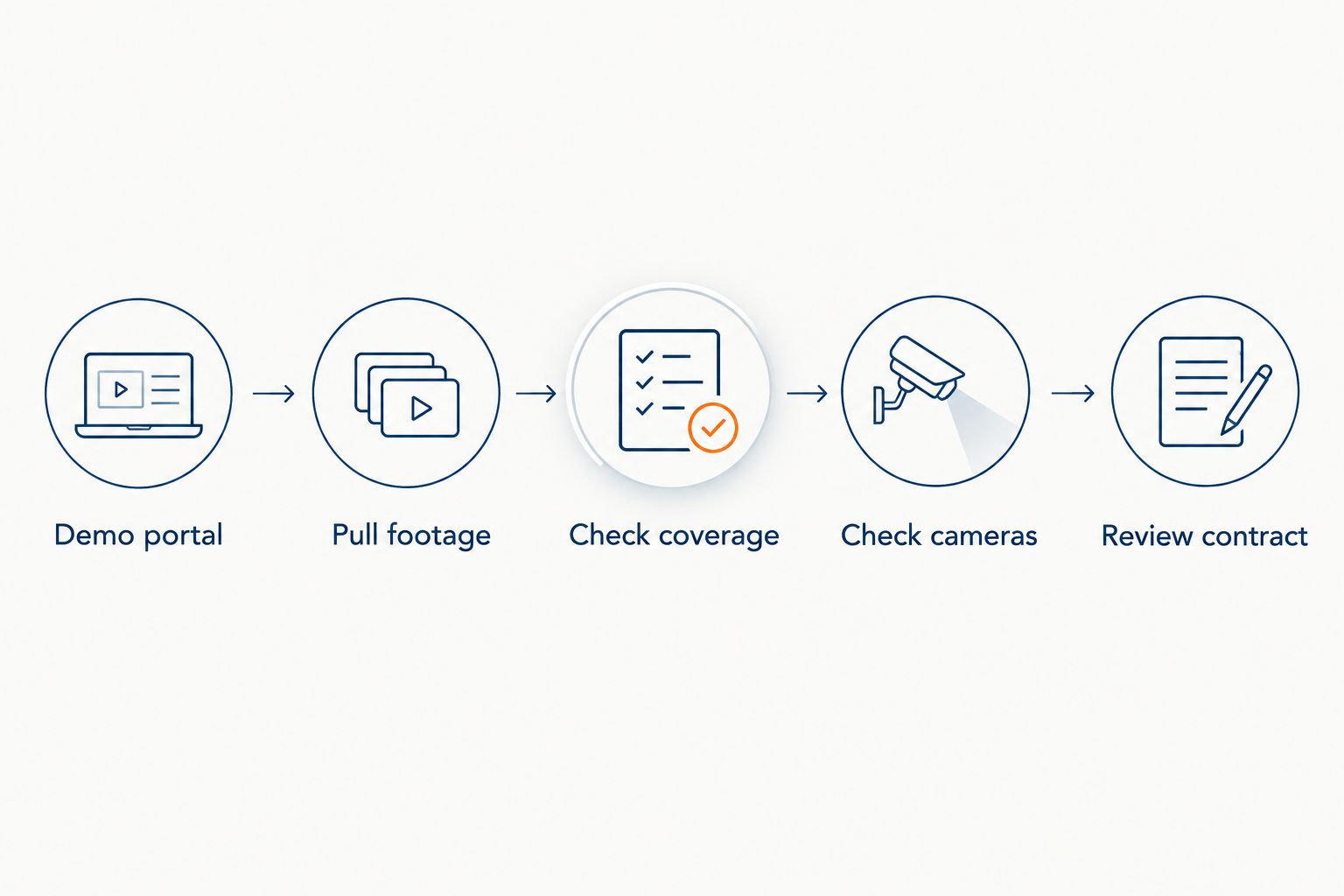
The portal step is where many buyers learn the most. If a system is awkward for you to use during a demonstration, it will be awkward every week afterwards. Crystal Ball explains what the portal shows in its guide to SmartCam customer portal footage and alerts, which is a useful list of things to ask any supplier to show you.
Test coverage on your own routes
A 4G dash cam depends on mobile networks to send data to the portal. Rural depots, tunnels and some industrial areas can have weak signal. Ask the supplier how the camera behaves in those places and test it on your hardest route, not your easiest one.
Crystal Ball covers this question in its guide to how SmartCam 4G works in areas with poor 4G coverage. Read it before your test so you know what to look for.
Test footage on the vehicles you actually run
A van cab, an HGV cab and a minibus all give different views. Test at least one vehicle of each type you run, not one convenient vehicle that stands in for the rest.
Watch the footage back at a desk, not on a phone in the yard. Check whether you can read number plates, see junction layouts and judge distances. Check that the view is not blocked by a sun visor, a windscreen sticker or a cab fitting.
If you want a second camera view, ask whether it is standard or optional. Optional cameras change both the scope of the install and the commercial terms, so test the exact configuration you intend to buy.
What a trial cannot prove
A short trial has limits, and it helps to know them before you rely on it.
- Long-term durability. A trial shows how the system behaves now, not after a year of vibration, heat and cleaning.
- Fleet-wide behaviour. A few vehicles do not show how the system handles a full fleet and many users.
- Seasonal conditions. Low winter sun, rain and darkness may not be present during your test window.
- Support quality over time. You see the sales team during a trial. Ask for references or a sample support response to learn what happens after you sign.
Treat the trial as one input. It reduces risk, but it does not remove it.
Why trial terms vary between suppliers
There is no single industry rule that says a supplier must offer a trial. What you are offered depends on several factors:
- Hardware and installation cost. A fitted pilot means fitting and removing equipment, which costs the supplier time.
- Fleet size. Larger prospective orders often get more room to negotiate a pilot.
- Product type. A system with a portal, optional cameras and alerts has more configurations than a simple standalone camera.
- Contract structure. Some suppliers prefer a short demonstration, then a standard agreement with defined exit terms.
- Installation logistics. Vehicles need to be available at a suitable time and place for a fitting.
Because the terms vary, never assume a trial exists because a competitor offers one. Ask, and get the answer in writing.
What to get in writing before you sign
Use this checklist when you ask any supplier for terms.
- Whether a fitted pilot is offered, how long it runs and whether it is charged for.
- What happens to the equipment and the data if you decide not to continue.
- Which cameras and functions are standard and which are optional.
- The contract length, notice period and any early exit conditions.
- What installation includes, and whether any part of it is charged separately.
- How long installation is expected to take per vehicle. Crystal Ball sets out realistic expectations in its guide to how long it takes to install a fleet dash cam system.
- How long footage is kept and who can access it. Crystal Ball covers this in its guide to dash cam footage retention for UK fleets. There is no single UK retention period for fleet dash cams, so set your own policy and check it matches the system.
Write down the answers. A verbal promise during a demonstration is hard to rely on once the contract is signed.
How Crystal Ball SmartCam 4G fits into a test
Crystal Ball SmartCam 4G combines vehicle tracking with video telematics. It is built for fleets that want connected tracking and camera information in one system, such as incident evidence, driver-behaviour information and digital vehicle checks.
Crystal Ball SmartCam 4G is best for fleets that want tracking and recorded video in one connected system, with footage reviewed on demand through the customer portal.
What to test on a SmartCam 4G demonstration:
- Footage access. Footage is recorded and accessed on demand through the customer portal. Ask to see the request process from start to finish.
- Camera views. A forward-facing camera is the base. Internal, rear and side cameras are optional, so check exactly which are in your configuration.
- Digital vehicle checks. SmartCam supports defect reporting. These checks support, but do not replace, your legal inspection, reporting, assessment and repair duties.
- Driver behaviour information. Ask the supplier to show only the functions currently available, and to say plainly which are not.
Honest pros and cons:
- Pro: tracking and video sit in one portal rather than two separate systems.
- Pro: a family-run UK team with dependable human support, which you can judge during the demonstration.
- Con: it is quote-led, so there is no public price to compare. You need a quotation for your exact configuration.
- Con: additional cameras are optional, so the configuration you test must match the one you buy.
If you want to see the portal and footage process for your own fleet, Request a Demo and ask Crystal Ball to cover the five steps above.
Related questions
Is a supplier demo enough to decide?
A demo is enough to shortlist, not enough to decide. It shows the portal and the functions, but it cannot show footage quality on your vehicles or coverage on your routes. Add a footage request and, where possible, a fitted pilot.
How many vehicles should I test?
Test at least one vehicle of each type in your fleet. A van, an HGV and a pool car give different camera views and different usage patterns, so one vehicle cannot represent all of them.
Should I tell drivers before a trial starts?
Yes. Tell drivers what is being recorded, why and who can see it before any camera is fitted, including during a trial. The Information Commissioner’s Office publishes guidance on data protection and monitoring workers, which sets out what you must tell workers about monitoring, and your policy should follow it.
What should I do if the trial goes badly?
Record what failed, such as image quality, coverage or portal usability, and send it to the supplier in writing. A good supplier will respond with a fix or a different configuration. If it does not, you have a documented reason to walk away.
FAQ
Can I test a fleet dash cam before signing a contract?
Usually you can test part of the system. A demonstration and footage request are the minimum to expect, while a fitted pilot must be agreed with the supplier in writing.
Do all fleet dash cam suppliers offer a free trial?
No. Trial terms vary by supplier, product and fleet size. Ask directly whether a trial is offered, what it costs and what happens when it ends.
What should I check during a fleet dash cam demo?
Check how you find a vehicle, a journey and an incident in the portal, and ask the supplier to retrieve footage while you watch. Confirm which camera views are standard and which are optional.
How do I get footage from Crystal Ball SmartCam 4G?
Footage is uploaded to the cloud. Authorised users retrieve and download it on demand, and event recordings upload automatically when an incident occurs. Check during the demo how quickly footage appears for your vehicles.
Is SmartCam 4G priced publicly?
No. SmartCam 4G is quote-led, so you need a quotation for your configuration. Make sure the quote matches the cameras you tested.
How long should footage be kept from a fleet dash cam?
UK law does not set one universal retention period for fleet dash cam footage. Set a policy that fits your purposes and check that the system can follow it.
What can a short trial not tell me?
A short trial cannot show long-term durability, fleet-wide behaviour, seasonal conditions or the quality of ongoing support. Use it alongside written terms and references.
One last thing
Bring the contract to the demonstration, not after it. Read each clause aloud and ask the supplier to show you the matching function or confirm the matching term. Anything they cannot show or confirm is a risk you are about to accept for the length of the agreement.
Explore the relevant Crystal Ball solution

SmartCam 4G Fleet Dash Cam
Integrated video telematics
On-demand footage, integrated tracking, incident evidence and digital vehicle checks where configured.
PRICE PROVIDED BY QUOTE