 Get in Touch
Get a Quote

Shared and pool vehicles create a blind spot for fleet managers: if nobody logs who drove where, journey data becomes almost useless for maintenance scheduling, fuel accountability or answering an insurer's questions after an incident. Fleet driver identification closes that gap by matching each journey to a specific person, not just a vehicle registration.
- Fleet driver identification pairs a fob or key tag to each driver and matches it automatically at ignition.
- Crystal Ball’s FleetTracker uses Automatic Driver Recognition (ADR) to log which driver used which vehicle on shared fleets.
- An unrecognised fob triggers an alert, so managers can follow up before an audit or claim, not after one.
- SmartCam 4G adds recorded video evidence alongside driver identification for shared vehicle disputes.
Why this matters
Shared vehicles change hands several times a day: pool cars for site visits, vans handed between shifts, HGVs shared across a depot rota. Without driver identification, tracking data only tells you where a vehicle went, not who was behind the wheel when it happened.
That gap matters when you're reconciling fuel card spend, scheduling a service against the driver who has been logging the most miles, or explaining to an insurer why a vehicle registered to twelve different names needs a single answer. Fleets already using SmartCam 4G for shared and pool vehicles know the video side of this problem well. Driver identification is the other half: confirming who was driving before anyone even looks at footage.
In 2026, more SMEs and local authorities are running pool car and shared van schemes to cut fleet size, which makes driver-level accountability harder to skip.
How fleet driver identification works for shared vehicles
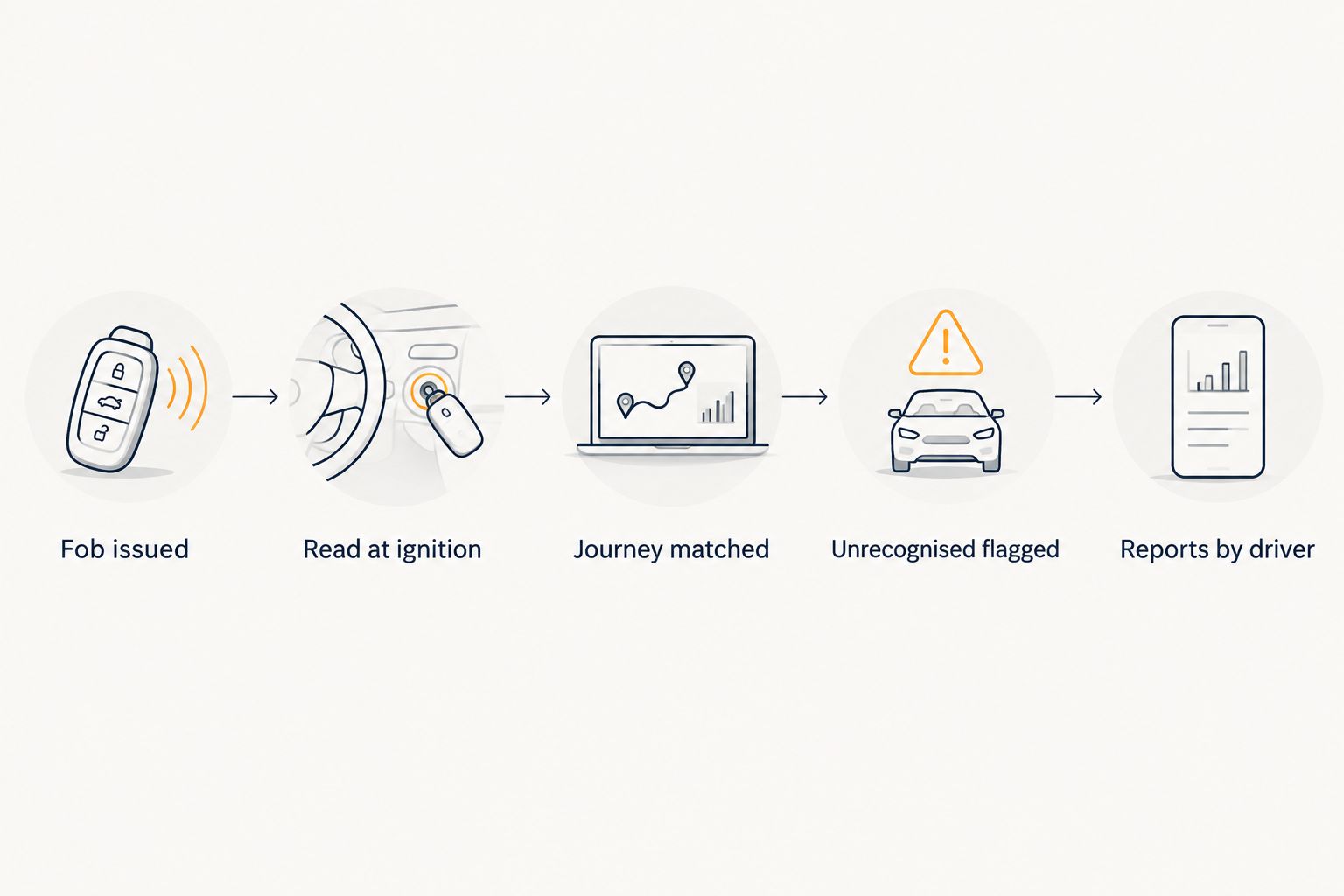
The process is consistent across most systems that use it, including Crystal Ball's FleetTracker:
- Each driver carries a small identifier, commonly a fob or key tag, registered to their name in the fleet management portal.
- At ignition, the vehicle's tracking unit reads the identifier and checks it against the registered driver list.
- The system logs that driver against the journey, alongside location, mileage and time data for the trip.
- If no identifier is presented, or one the system doesn't recognise, the vehicle can usually still start, but the journey is flagged as unassigned.
- Reports then group journeys, mileage and driver behaviour data by person, even though the vehicle itself changed hands several times that week.
Getting this right starts with clean records. Most fleets treat identifier issuing as part of onboarding drivers onto a new tracking system rather than a separate admin task bolted on afterwards.
Why driver identification results vary across shared fleets
Two fleets running the same technology can get very different results. The outcome depends on a handful of factors:
- Identifier discipline: whether drivers actually tap or scan before starting the engine, every time, not just when it's convenient.
- Booking systems: whether a separate pool car booking log is cross-checked against the identification data, or the two run in isolation.
- Vehicle rotation frequency: a van shared across three shifts a day generates more unassigned-journey risk than one driven by the same person all week.
- Multi-site sharing: vehicles moved between depots or sites need identifiers that work everywhere, not just at the home base.
- Alert review habits: unrecognised-fob alerts only help if someone actually checks them, cross-referencing against journey history data rather than letting them pile up.
- Driver turnover: temporary or agency drivers who haven't been registered yet are the most common source of unassigned journeys.
Fleets that treat this as a one-off setup task rather than an ongoing process tend to see identification data degrade within a few months, as new starters and agency cover slip through the registration process.
Does driver identification work without a fob?
Driver identification without a fob or equivalent identifier cannot tell you who drove a shared vehicle, only that it moved between two points. Some businesses rely on manual sign-out sheets alongside GPS data as a workaround, but that depends entirely on drivers filling the sheet in correctly, which is exactly the accountability problem driver identification is meant to solve.
Can driver identification stop unauthorised use of a shared vehicle?
Driver identification on its own does not stop a vehicle starting. It flags the journey as unassigned so a manager can review it afterwards, rather than preventing the trip in the first place. Fleets that need the vehicle disabled when no authorised driver is present are looking at a different function: Thatcham S5 Plus adds immobilisation when its fob is absent, which is a security feature rather than a fleet identification one.
How is driver identification different from GPS vehicle tracking?
GPS vehicle tracking shows where a vehicle is and where it has been. Driver identification adds who was driving during that journey, which turns a location record into an accountable one. For pool and shared vehicle setups, the two work together: tracking supplies the route and timing, identification supplies the name attached to it. Businesses running formal pool schemes often pair this with pool car scheme fleet software that handles bookings alongside the identification data.
Where Crystal Ball fits
FleetTracker is the simplest fit for shared fleets that need driver-level reporting without camera evidence: Automatic Driver Recognition (ADR) logs which driver used which vehicle, on top of the location, mileage and reporting functions already built into the platform. Where disputes or incidents are a bigger concern, such as pool cars used by multiple departments, SmartCam 4G adds recorded video evidence to the same driver identification data, accessed on demand through the customer portal rather than as a live stream.
Neither product replaces the other. FleetTracker handles the identification and reporting layer; SmartCam 4G adds the visual record when a journey needs more than a name attached to it.
FAQ
What is fleet driver identification?
Fleet driver identification is the process of matching a specific journey to a specific driver, usually through a fob or key tag read at ignition. It turns location data that only shows a vehicle’s movements into a record that also shows who was driving.
Does driver identification require a fob for every driver?
Yes, a fob or equivalent identifier assigned to each driver is how the system tells drivers apart. Without one, journeys on a shared vehicle can’t be reliably attributed to a specific person.
Can driver identification show who drove a pool car after the fact?
Yes, reports group past journeys by driver rather than by vehicle, so a manager can pull up who used a specific pool car on a given day. This depends on the driver having presented their fob at the time.
Is driver identification the same as Automatic Driver Recognition (ADR)?
Automatic Driver Recognition (ADR) is Crystal Ball’s term for its driver identification feature within FleetTracker. The underlying function is the same: matching a journey to a registered driver at ignition.
How does driver identification help with fuel card fraud?
Driver identification ties fuel usage patterns to a specific person rather than a vehicle, making it easier to spot inconsistent fuel card use against a driver’s actual journeys. It works alongside fuel card reconciliation rather than replacing it.
What happens if a driver forgets their fob?
The vehicle can usually still be started, but the journey is logged as unassigned rather than attributed to a driver. Reviewing unassigned journeys regularly catches these gaps before they affect a report or an audit.
Does SmartCam 4G include driver identification?
SmartCam 4G includes the FleetTracker functions it’s built on, which cover driver identification through Automatic Driver Recognition (ADR), plus recorded video telematics on top. The two aren’t separate systems for a fleet running SmartCam 4G.
Can driver identification data be used in an insurance claim?
Driver identification data can support a claim by confirming who was driving a shared vehicle at the time of an incident. Video evidence from a dash cam system strengthens that record further, since identification alone only names the driver, not what happened.
One last thing
The biggest failure point in fleet driver identification isn't the hardware, it's the review habit. A fob system that logs every unassigned journey is only useful if someone actually checks that report; set it as a fixed weekly task rather than something you glance at after a problem has already surfaced. Fleets that do this in 2026 catch registration gaps, like a new agency driver who hasn't been set up yet, within days rather than after the next audit.
Request a demo to see how FleetTracker’s Automatic Driver Recognition (ADR) works for a shared or pool fleet.
Explore the relevant Crystal Ball solution

Crystal Ball FleetTracker
Live vehicle location, journey history, geofences, supported alerts, mileage, utilisation and fleet records.
Related guides