 Get in Touch
Get a Quote

HGV operators running vehicles above 12 tonnes gross vehicle weight in Greater London now work to a tougher Direct Vision Standard, introduced on 28 October 2024, and this guide sets out exactly what changed and what your fleet needs to stay compliant through 2026.
- DVS October 2024 requirements raised the minimum HGV safety permit rating to 3-star for most vehicles.
- Vehicles below 3-star need a full Progressive Safe System fitted to keep operating in Greater London.
- Crystal Ball’s DVS Kit combines camera, sensor and warning equipment for operators facing a 2026 permit renewal.
- Check your vehicle’s star rating before booking any equipment. Some fleets already clear the threshold.
- Permits issued before October 2024 do not automatically meet the new rating. Recheck every vehicle in 2026.
Why DVS matters for HGV operators in 2026
Any HGV over 12 tonnes gross vehicle weight needs a valid safety permit to enter or operate within Greater London. Transport for London assesses each vehicle's direct vision from the cab, meaning how much of the road, pedestrians and cyclists a driver can see without relying on mirrors or cameras, and gives it a star rating from 0 to 5.
Before 28 October 2024, a vehicle only needed to reach the lowest rating band, or fit basic safety equipment, to qualify. That threshold moved up. Most vehicles rated below 3-star now need a full Progressive Safe System fitted before TfL will issue or renew a permit. Read the DVS HGV safety permit process in full if you have not applied before.
The practical effect for a fleet manager: an older cab design that scraped through in 2020 or 2021 may no longer qualify without extra equipment in 2026. Operators who assume their permit is still valid because nothing has changed on the vehicle are the ones most likely to get caught out at renewal.
1. Check your vehicle's current DVS star rating
Start by confirming where each vehicle sits on the 0 to 5 star scale. TfL publishes the rating method and a searchable vehicle checker, and most manufacturers can confirm the cab's rating for a given model and year.
- Pull the chassis or VIN for every HGV over 12 tonnes in the fleet.
- Check the rating against TfL's published tool rather than a dealer estimate from several years ago.
- Note the permit expiry date alongside the rating, not just the rating on its own.
- Flag any vehicle rated 0, 1 or 2 stars for the next step.
- Keep a simple spreadsheet rather than relying on memory across a mixed fleet.
2. Confirm whether you need a Progressive Safe System
A vehicle rated 3-star or above generally meets the current minimum without extra equipment. Anything below that needs the full Progressive Safe System to keep its permit, and this is where most of the October 2024 change actually lands for operators.
- Confirm the exact rating band with TfL, not an assumption based on vehicle age.
- Check whether the vehicle already has any PSS components fitted from a previous compliance round.
- List what is missing rather than replacing equipment that already meets the standard.
- Ask your dealer or bodybuilder whether the cab design itself can be upgraded before adding sensors.
- Budget for the full system, not just the camera, since a partial fit will not satisfy TfL.
3. Fit a Camera Monitoring System for blind spots and moving off
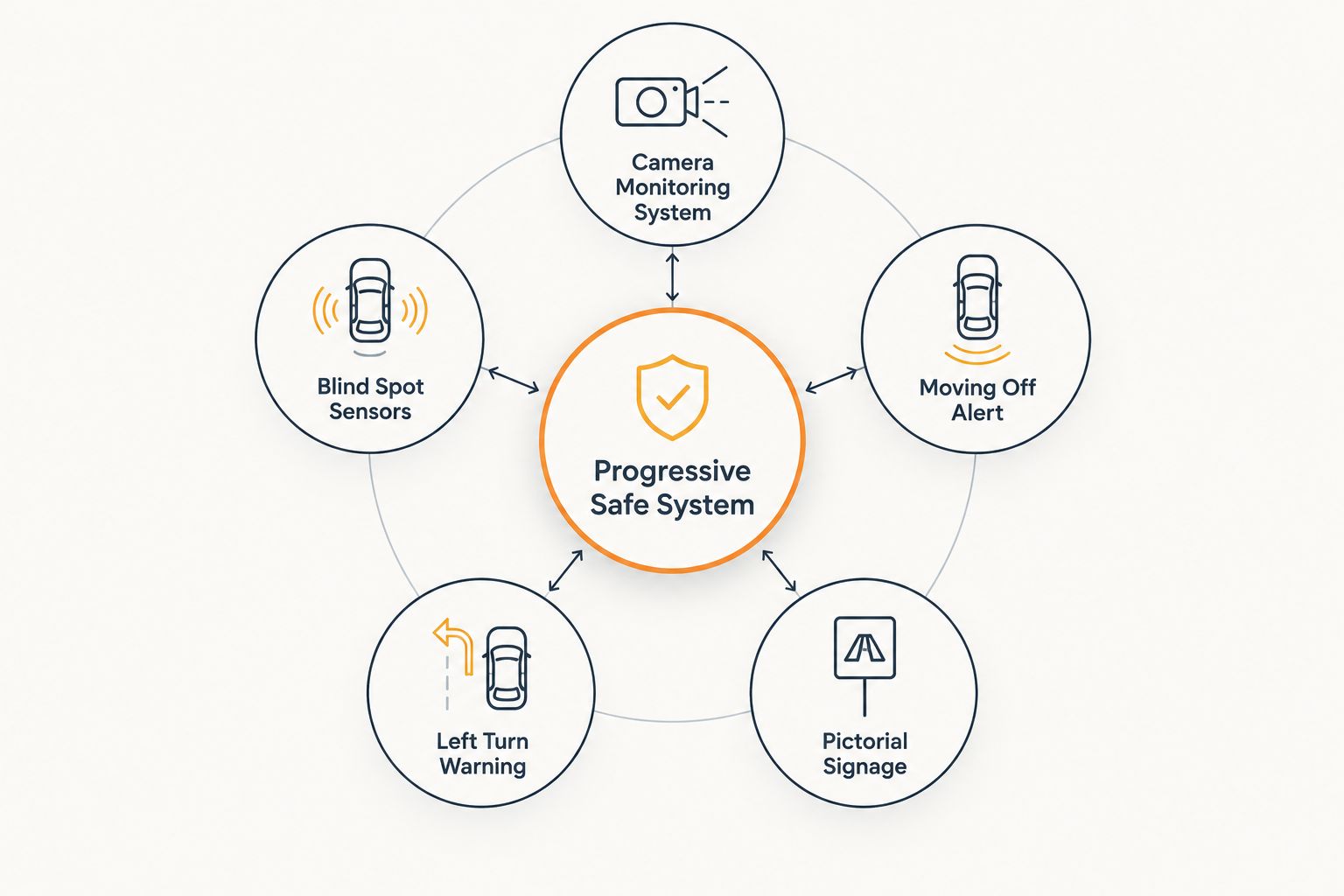
The Progressive Safe System has two core camera-based requirements: a Blind Spot Information System covering the near side, and a Moving Off Information System covering the area directly in front of the cab.
- A near-side camera or sensor set that flags cyclists and pedestrians in the blind spot.
- A front-facing detection system that warns the driver before moving off.
- An in-cab monitor or clear audible signal the driver actually notices, not one buried in ambient cab noise.
- Coverage that matches the specific cab height and mirror layout of that vehicle, not a generic bracket.
- Documentation confirming which system was fitted, for the permit application itself.
4. Add a left turn audible warning
A speaker or external audible device that sounds when the vehicle indicates left is a specific, separate requirement from the camera system. It is designed to alert cyclists and pedestrians near the vehicle who may not see the driver's signal.
- Confirm the device triggers automatically with the left indicator, not a manual switch.
- Check volume is set within the range TfL specifies rather than left at a factory default.
- Have the fitting checked as part of the same visit as the camera system, not a separate booking.
- Read the current wording on left turn warning speakers before choosing a device.
- Test the warning after fitting, on a quiet stretch of yard, before the vehicle goes back on the road.
5. Apply the required pictorial warning signage
External stickers warning cyclists and pedestrians about the vehicle's blind spots are a fixed, low-cost part of the Progressive Safe System, and TfL is specific about placement and design.
- Confirm the exact current wording and design required for pictorial warning signage requirements.
- Check signage is placed on both sides and the rear, not just the near side.
- Replace faded or damaged signage as part of routine vehicle checks, not only at permit renewal.
- Keep spare signage in stock for vehicles moved between depots or repainted.
- Photograph the finished signage for your compliance file.
6. Apply for or renew your DVS safety permit
Once the vehicle's rating and equipment are confirmed, the permit application itself is administrative, but it needs every piece of evidence lined up correctly.
- Submit vehicle registration, rating evidence and PSS installation confirmation together.
- Apply well ahead of the vehicle's next planned London job, since processing is not instant.
- Check the permit's stated expiry date and set a reminder well before it lapses.
- Keep a copy of the approved permit in the cab alongside other vehicle documents.
- Renew every vehicle separately. A fleet-wide permit does not exist.
7. Keep compliance evidence ready for audit
TfL and DVSA can both ask for evidence that a vehicle's PSS is genuinely fitted and working, not just paperwork from installation day.
- Store installation certificates and dated photos for each vehicle.
- Log any equipment faults and the repair date, not just the original fitting.
- Run periodic checks that the audible warning and camera system still work, since sensors can fail quietly.
- Use a DVS compliance audit checklist to standardise what gets checked and when.
- Keep records centrally rather than with individual drivers or depots.
8. Monitor compliance across the whole fleet, not just one vehicle
A single non-compliant HGV entering Greater London without a valid permit creates risk for the whole operation, so ongoing monitoring matters more than a one-off fitting exercise.
- Track every vehicle's permit expiry date in one place, not spread across depots.
- Review new vehicles entering the fleet against the current rating standard before they are scheduled into London work.
- Pair PSS equipment with a wider 360° Camera System where broader blind-spot visibility is also needed, since the two solve related but separate problems.
- Assign one person or team ownership of DVS compliance rather than leaving it to whoever books the MOT.
- Reassess the fleet annually, since TfL has already tightened the standard once and may do so again.
Crystal Ball's DVS Kit brings the camera monitoring system, sensors, audible left turn warning and current pictorial signage together as one fitted package for operators who would rather coordinate one supplier than several. It sits alongside FleetTracker and SmartCam 4G in the wider Crystal Ball ecosystem, but DVS compliance itself depends on the specific equipment above, not on tracking or dash cam hardware.
Comparing your options for meeting DVS requirements in 2026
| Option | Best for | Key limitation |
|---|---|---|
| Retrofit PSS components separately from multiple suppliers | Operators with one or two vehicles needing a quick fix | Coordinating fitting dates, warranties and evidence across suppliers |
| Crystal Ball DVS Kit as one integrated fit | Fleets wanting a single supplier for the whole Progressive Safe System | Quote-led pricing, so no published cost without a direct enquiry |
| Replace the vehicle with a higher star-rated cab | Operators already due a fleet renewal | High capital cost, and it does not solve compliance for vehicles staying in service |
| Apply for permit without PSS on a vehicle already rated 3-star or above | Operators whose existing fleet already clears the new threshold | Only applies if the rating genuinely meets the current minimum, not the pre-2024 one |
Common mistakes HGV operators make with DVS compliance
- Assuming a 360° camera system fitted for general blind-spot visibility automatically satisfies PSS requirements, when the audible warning and signage are still separate obligations.
- Treating a permit issued before 28 October 2024 as still valid indefinitely, without checking it against the new 3-star minimum.
- Fitting PSS equipment to some vehicles in the fleet and assuming the rest are covered by association.
- Losing installation certificates and photos, then struggling to prove compliance when DVSA or TfL asks for evidence.
- Booking equipment before checking the vehicle's actual star rating, and paying for a system the vehicle did not need.

FAQ
What changed with the DVS October 2024 requirements?
From 28 October 2024, Transport for London raised the minimum Direct Vision Standard rating most HGVs need for a safety permit to 3-star. Vehicles below that rating need a full Progressive Safe System fitted instead.
Which HGVs need a DVS safety permit?
Any HGV over 12 tonnes gross vehicle weight operating in Greater London needs a valid DVS safety permit. The permit depends on the vehicle’s star rating or, below the current minimum, a fitted Progressive Safe System.
Does a 360 degree camera system meet DVS requirements on its own?
No. A 360 degree camera system improves general blind-spot visibility but does not by itself satisfy the Progressive Safe System, which also requires a left turn audible warning and current pictorial signage.
How do I check my HGV’s current DVS star rating?
Check the vehicle against TfL’s published Direct Vision Standard rating tool using the chassis or VIN, or ask the manufacturer to confirm the cab’s rating for that model and year.
Is a permit issued before 2024 still valid in 2026?
A permit issued before the October 2024 change does not automatically meet the new 3-star minimum. Recheck the vehicle’s rating and equipment before assuming an existing permit still applies.
What equipment does the Progressive Safe System actually include?
The Progressive Safe System includes a camera monitoring system covering blind spots and moving off, a left turn audible warning, and pictorial warning signage fitted to the vehicle.
Can Crystal Ball fit DVS equipment as one package?
Crystal Ball’s DVS Kit combines the camera monitoring system, sensors, audible left turn warning and current signage as one fitted package for HGV operators, quoted per vehicle.
What happens if an HGV enters London without a valid DVS permit?
Operating an HGV over 12 tonnes in Greater London without a valid safety permit puts the operator at risk of penalties from Transport for London, separate from any wider operator licence consequences.
One last thing
The detail operators miss most often is that DVS compliance is assessed vehicle by vehicle, never fleet-wide. A depot with twelve HGVs at 3-star or above and one older cab sitting at 1-star has exactly one non-compliant vehicle, and TfL treats it that way. Check every registration individually before the next renewal date, not just the vehicles due an MOT.
Talk to Crystal Ball to request a quote for DVS equipment sized to your fleet’s current star ratings.
Explore the relevant Crystal Ball solution

Crystal Ball Direct Vision Standard Kit
Progressive Safe System equipment for relevant HGVs operating in Greater London.
£599 INCLUDING VAT FOR EQUIPMENT. INSTALLATION IS PRICED SEPARATELY WHERE REQUIRED.
Related guides