 Get in Touch
Get a Quote

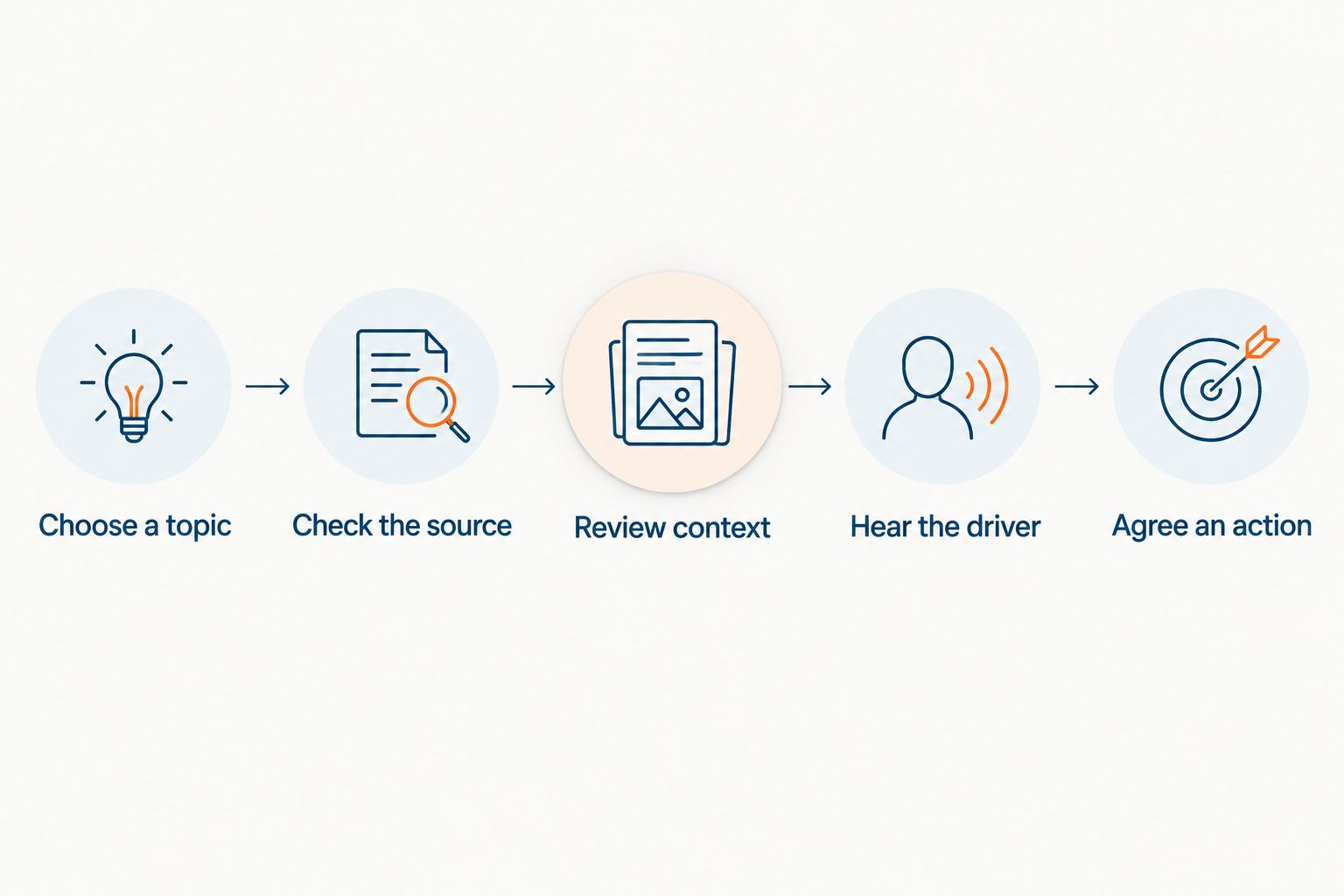
Use SmartCam 4G data in driver coaching by choosing a specific event, checking the available footage against its journey context, and discussing one observable behaviour with the driver. Agree on an action, then review subsequent events against the same behaviour. Treat alerts as prompts to investigate, not proof that a driver was at fault.
- Dash cam driver coaching works best when a manager checks recorded footage and journey context before discussing an event.
- Crystal Ball SmartCam 4G is best for fleets needing recorded road footage alongside supported driver-behaviour data for coaching.
- Agree on one observable action, record the driver’s account and review comparable events later.
- Explain how footage is used, who can access it and how long relevant records are kept.
Why this matters
A speeding alert or a piece of footage tells you what needs attention; it does not tell you everything that happened. A useful coaching conversation separates what the system recorded from what the manager assumes. That distinction helps you address a driving decision without turning every alert into an accusation.
In 2026, the practical test for a fleet coaching process is whether a driver can understand why an event was selected and what they are being asked to change. Crystal Ball's SmartCam driver-behaviour monitoring guide provides related product context. For the coaching session itself, keep the evidence, the driver's account and the agreed action distinct.
How do you use SmartCam 4G data in driver coaching sessions?
Follow these steps in order. The aim is a fair, repeatable discussion about driving behaviour, not a verdict produced by a camera.
- Choose a coaching topic. Select an event or supported behaviour that you can describe clearly, such as speeding or harsh braking where the relevant information is available in your configuration. Avoid collecting unrelated clips to make a general case against a driver.
- Check the source. Identify whether the point comes from a recorded clip, a telematics event, a journey record or an alert. These sources answer different questions; an alert alone does not show the full road situation.
- Review the context. Check the available footage on demand and compare it with the event's time and journey information. Note what the camera shows and what remains outside its view.
- Invite the driver's account. Describe the observable event before asking for an explanation. Let the driver identify conditions or instructions that the recording cannot establish.
- Agree on one action. State the behaviour to practise and how you will recognise it in a later review. Keep the action within the driver's control.
- Record the outcome. Keep a concise note of the evidence discussed, the driver's account and the agreed action under your organisation's access and retention rules.
- Review fairly. Examine comparable later events, including any relevant improvement. If the same concern persists, check the evidence and context again rather than treating the first discussion as proof of every later event.
Start with the question the evidence can answer
Before opening footage, write down the coaching question. Was the concern the driver's speed, their response to a developing hazard or something else? A narrow question prevents a meeting about one event from becoming a review of everything visible in a journey.
Crystal Ball SmartCam 4G combines tracking with video telematics. Its recorded footage can be accessed on demand through the customer portal; it is not continuous live video streaming. That makes it important to confirm which footage is available for the event you intend to discuss, rather than assuming you can watch an entire shift.
Separate observation from interpretation
Write an observation in plain language: the footage shows the vehicle approaching a junction, or the event record flags harsh braking. Then write down what still needs checking. The footage might not establish what another road user did outside the camera view, and a braking event does not explain why the driver braked.
This separation matters when you speak to the driver. Ask what happened at the point shown, then compare their account with the available recording and journey context. Do not describe a system flag as a confirmed driving error. If the evidence does not establish the behaviour, close that line of coaching rather than stretching the claim.
Run the conversation around a specific behaviour
Open with the event, not a judgement about the person. Show or describe the relevant recording, identify the matching journey information and ask the driver what they noticed. Keep unrelated observations out of the session unless they are needed to understand the same event.
The next question is practical: what would the driver do differently when a similar situation arises? An answer such as allowing more time to respond to a developing hazard is more useful than a vague instruction to drive better. Make sure the agreed action matches what the evidence shows; do not prescribe a change based on a camera angle that missed the decisive moment.
Driver-behaviour measures need the same care. A score or trend, where supported and available, can help you decide what to review, but it cannot replace the event-level discussion. The SmartCam driver scores and league tables guide covers that distinction in more detail. Use a measure to find a question, then use the available evidence and the driver's account to answer it.
Finish with a follow-up the driver understands
End the session by repeating the behaviour, the agreed action and how you will review it. Tell the driver what will be recorded from the conversation. If the underlying concern relates to a route, vehicle assignment or instruction, record that issue separately rather than making the driver responsible for something outside their control.
At the follow-up, examine comparable situations. A different route or a single uneventful journey does not, by itself, settle whether the agreed behaviour has changed. Equally, a fresh alert needs its own context. Apply the same standard of evidence you used in the first session.
Why coaching outcomes vary
A consistent process does not make every alert equally useful. These factors change what you can establish and how you should respond:
- Evidence available: An event record, recorded footage and journey information each show a different part of what happened. Check which sources you actually have.
- Camera view: A forward-facing recording cannot show everything beside or behind the vehicle. Do not infer an unseen road user's actions.
- Event context: The driver's account and the surrounding journey help distinguish a driving choice from a response to a developing situation.
- Supported configuration: Discuss only behaviour measures and camera views that are confirmed for your SmartCam 4G setup. Do not assume optional cameras or detection functions are present.
- Comparable follow-up: Review the same behaviour in a relevant later context, rather than claiming success or failure from an unrelated journey.
- Access and retention: Your ability to review an event depends on the footage and records available under your organisation's rules.
These factors belong in the coaching note where they affect your interpretation. They also make a useful check on whether the discussion is ready to happen: if you cannot identify the event, its source and its limits, investigate before scheduling the meeting.
How should you handle footage and driver data?
Tell drivers how recorded footage and telematics data are used for coaching, who can access them and how concerns can be raised. The ICO’s guidance on monitoring workers states that you must identify a lawful basis to lawfully collect and process information from monitoring workers, and that transparency means being clear with workers about how and why you process their information. Keep access limited to the people who need it for the stated purpose. Apply your organisation's data-protection and retention rules before sharing clips or adding them to personnel records.
There is no single UK fleet dash-cam retention period that applies to every recording. In 2026, set a documented approach that reflects why you hold the data, then distinguish routine footage from material needed for an identified incident or dispute. The vehicle telematics data retention guide addresses the wider question of keeping vehicle data.
Coaching is also different from investigating a serious allegation. Do not promise a driver that a recording will only ever be discussed informally if your organisation has other lawful, stated uses for it. Be clear about the purpose of this meeting and follow the appropriate internal process if the issue changes.
When should an alert lead to a coaching session?
An alert should lead to coaching when the underlying evidence supports a specific, explainable behaviour and a useful action. First check what triggered it and whether recorded footage or journey context is available. If the evidence is incomplete, investigate the event without treating the alert as a finding.
Labels can obscure that distinction. Even a discussion of AI cameras for trucks cannot establish what your own system detected, whether the function is active or what a particular recording proves. In 2026, check the capabilities and configuration of the equipment you use before attributing a behaviour to automated detection. Do not assume a marketed camera function exists in SmartCam 4G.
A repeat alert is still a new event. Look at its circumstances and give the driver a chance to respond. If the same supported behaviour keeps appearing in comparable situations, you have a clearer basis for a focused follow-up than you do from a count of alerts alone.
Can you coach drivers without reviewing every recording?
Yes. Choose events tied to a defined coaching question and review the evidence relevant to those events. Routine access to unrelated recordings adds work and makes it harder to explain why one driver was selected for a discussion.
Crystal Ball SmartCam 4G suits fleet managers who need recorded road footage alongside supported behaviour information when an event calls for review. It is not a substitute for a clear coaching policy or for hearing the driver's account. In 2026, specify how events are selected before the first session, then apply that approach consistently across the fleet.
What should a driver coaching note contain?
Record the event you discussed, the sources you checked, what each source showed, the driver's account and the agreed action. Distinguish an established observation from an unresolved question. Your note should let someone reading it later understand why the action was agreed without presenting an assumption as fact.
Keep the note proportionate. A coaching record does not need every clip from the journey or a broad assessment of the driver's character. If there is a dispute about what the footage shows, document that disagreement rather than rewriting it as agreement.
FAQ
How do you use dash cam footage in a driver coaching session?
Show the relevant recorded event, explain what it demonstrates and ask for the driver’s account before agreeing an action. Check the journey context and state what the camera cannot establish.
Is a SmartCam 4G alert proof of unsafe driving?
No. A SmartCam 4G alert identifies an event to review, not a complete explanation of what happened. Check the available evidence and hear the driver’s account before reaching a conclusion.
Does SmartCam 4G provide continuous live video for coaching?
No. SmartCam 4G footage is recorded and accessed on demand through the customer portal. Check which recording is available for the event under review.
Can a driver score replace a coaching conversation?
No. A supported driver score can help identify a topic for review, but it does not explain an individual event on its own. Discuss the available evidence and the driver’s account.
What if the footage does not show why a driver braked?
Do not treat the braking event as proof of an error. Ask the driver what happened and record the limits of the footage before deciding whether coaching is appropriate.
How long should fleet dash-cam footage be kept for coaching?
There is no single UK fleet dash-cam retention period for every recording. Apply a documented retention approach based on the purpose for holding the footage and your organisation’s data-protection rules.
What should happen after a driver coaching session?
Record the agreed action and review comparable later events using the same evidence standard. Tell the driver how the follow-up will work and consider their account of any new event.
One last thing
The strongest 2026 coaching note includes the limits of the evidence, not just the finding. If the camera missed a relevant action or the event record cannot explain the cause, write that down. A fair session can end with no corrective action when the available information does not support one.
If you want to see how recorded footage and journey context appear together before you design a coaching process, request a demonstration of SmartCam 4G and ask which behaviour measures are supported in your configuration.
Explore the relevant Crystal Ball solution

SmartCam 4G Fleet Dash Cam
Integrated video telematics
On-demand footage, integrated tracking, incident evidence and digital vehicle checks where configured.
PRICE PROVIDED BY QUOTE
Related guides