 Get in Touch
Get a Quote

SmartCam 4G driver behaviour monitoring turns recorded video telematics into a working coaching routine for UK fleet managers, using Driver Score data, harsh-event alerts and on-demand footage to explain what actually happened on the road in 2026.
- SmartCam 4G driver behaviour monitoring pairs recorded video telematics with Driver Score alerts, best for fleets that need evidence behind every coaching conversation.
- Footage is retrieved on demand through the customer portal, not streamed live, so reviews happen after an event rather than during it.
- FleetTracker alone tracks location and mileage; it carries no camera footage or video evidence for behaviour coaching.
- League tables and AI-based fatigue and distraction alerts only change driving habits when someone reviews them on a set schedule.
Why driver behaviour monitoring matters for UK fleet managers
Every fleet manager eventually has the same argument. A driver says the near miss wasn't their fault, or a claims handler asks for proof of what happened before impact. Telematics without video answers half of that question. SmartCam 4G driver behaviour monitoring exists to answer the other half, turning speed, braking and cornering data into a recorded picture of how a vehicle was actually driven.
For SME and local government fleets running cars, vans and HGVs, this matters more in 2026 than it did five years ago. Insurers ask more pointed questions about driver risk management, and disputed claims move faster when there's footage attached rather than a written statement. Fleet managers already running structured programmes often start by learning how to cut fleet accident rates with driver behaviour monitoring, then work back from there to decide which alerts and thresholds actually fit their fleet.
Crystal Ball built SmartCam 4G to sit inside that decision, combining tracking with video telematics rather than treating cameras and location data as separate systems.
How to run SmartCam 4G driver behaviour monitoring properly
Set a baseline before you switch on alerts
Switching on every alert on day one gives you noise, not insight. Run SmartCam 4G quietly first so you know what normal driving looks like on your routes before you start flagging exceptions.
- Review journey history for two to four weeks before enabling driver-facing alerts
- Note recurring routes with tight turns, low bridges or narrow yards separately from genuine harsh-event patterns
- Share the baseline with drivers so the programme isn't a surprise
- Tell drivers what is being monitored and why, in line with ICO guidance on monitoring workers
- Agree with HR or a driver representative what "normal" looks like for the fleet
- Record the baseline date so improvement can be measured against it later
Turn on Driver Score and set your own thresholds
SmartCam 4G's Driver Score aggregates supported driving events, which may include harsh acceleration, harsh braking, harsh cornering, speeding and idling, into a single comparable figure per driver. A van doing tight urban drops needs a different threshold to an HGV on trunk roads, so one blanket setting rarely works.
- Set different thresholds for vans versus HGVs rather than one blanket score
- Separate genuinely harsh events from route-specific quirks identified in your baseline
- Decide who sees individual scores versus aggregate fleet figures
- Set a review cadence, weekly works better than monthly for new programmes
- Agree what triggers a coaching conversation rather than just a warning
A Driver Score only changes behaviour when someone looks at it on a set schedule, not when it's simply switched on.
“A Driver Score only changes behaviour when someone looks at it on a set schedule, not when it’s simply switched on.”
Configure alerts for harsh driving events
Start narrow. SmartCam 4G supports alerts for events such as speeding, unexpected movement and geofence breaches where currently enabled, and switching all of them on at once buries the ones that matter.
- Start with two or three alert types rather than switching on everything at once
- Route alerts to the manager responsible for that vehicle, not one central inbox
- Set escalation rules for repeated alerts within a set period
- Test alert delivery on one vehicle before rolling out fleet-wide
- Review false-positive rates in the first month and adjust thresholds
Review AI-based fatigue and distraction alerts on a set schedule
Where currently supported on your account, SmartCam 4G's AI fatigue and distraction detection flags behaviours that raw tracking data can't see, such as signs of drowsiness or phone use at the wheel. Treat these as prompts to look closer, not automatic verdicts.
- Check alerts weekly rather than only after an incident is reported
- Cross-reference distraction alerts against shift length and route type
- Flag repeated fatigue alerts to a manager for a direct conversation, not just a log entry
- Keep a record of how each alert was actioned for audit purposes
- Avoid treating a single alert as proof of a pattern
Use Driver Score league tables to drive change, not blame
League tables work when drivers see them as a coaching tool, not a leaderboard for discipline. Crystal Ball's approach to Driver Score and league tables is designed to show trend over time, which is more useful than a single week's snapshot.
- Share improvement, not just ranking, month on month
- Recognise drivers who move up the table, not only the ones near the bottom
- Keep league tables internal and framed around coaching first
- Compare like with like, van drivers against van drivers, not against HGV drivers
- Reset the table periodically so an early low score doesn't follow a driver indefinitely
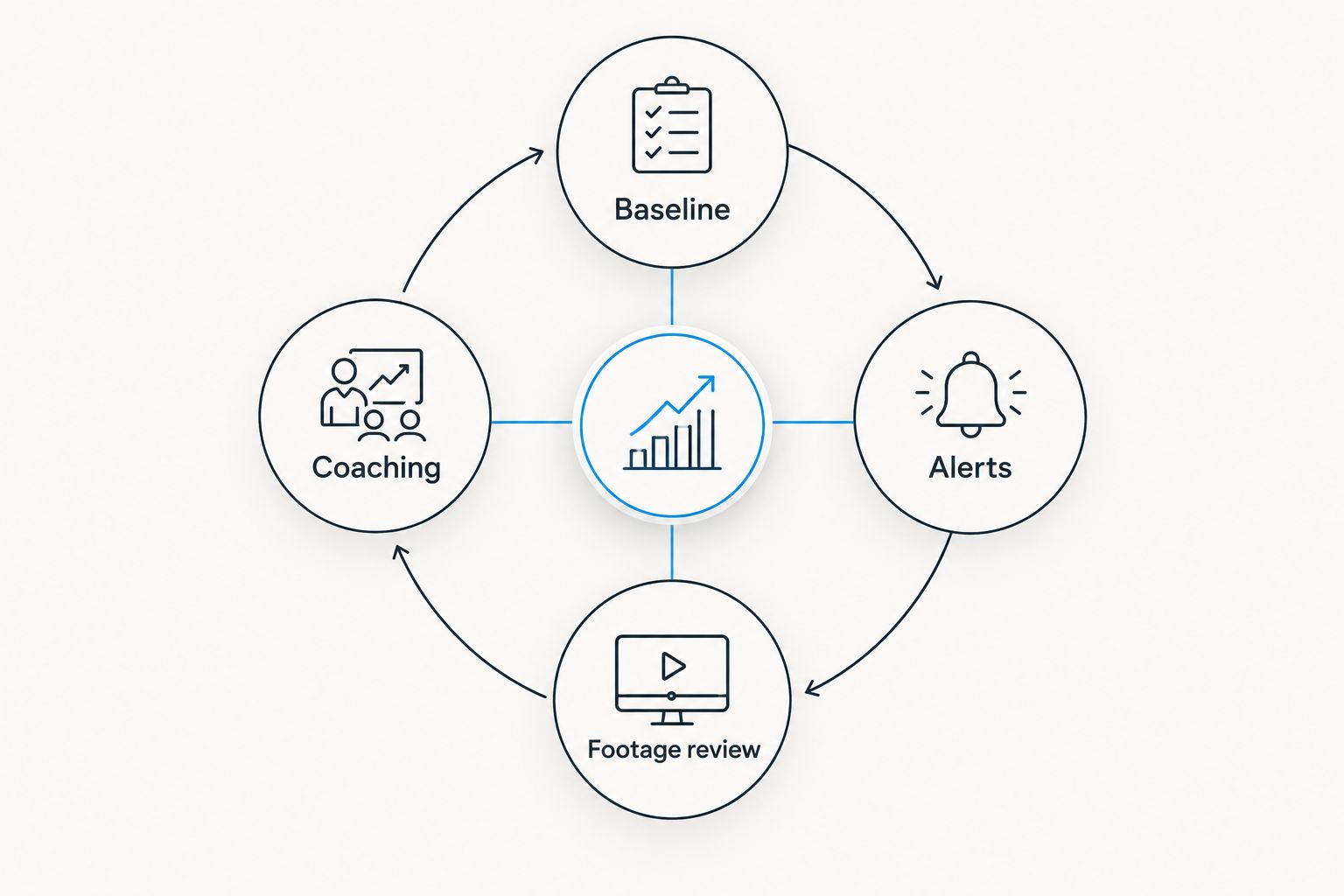
Pair footage review with coaching conversations
Footage retrieved through the portal is most useful watched with the driver present, not summarised to them afterwards. Footage clarity is usually the first thing a driver questions in a review, and many fleet operators benchmark resolution against 4K dash cams on the wider market before deciding what counts as genuinely usable evidence for their own coaching standard.
- Pull footage for the specific event, not a general trawl through the day
- Watch it with the driver rather than describing it to them
- Ask what they saw, not just what the camera recorded
- Note any road, lighting or vehicle condition that affected the event
- Log the outcome of the conversation against the driver's record
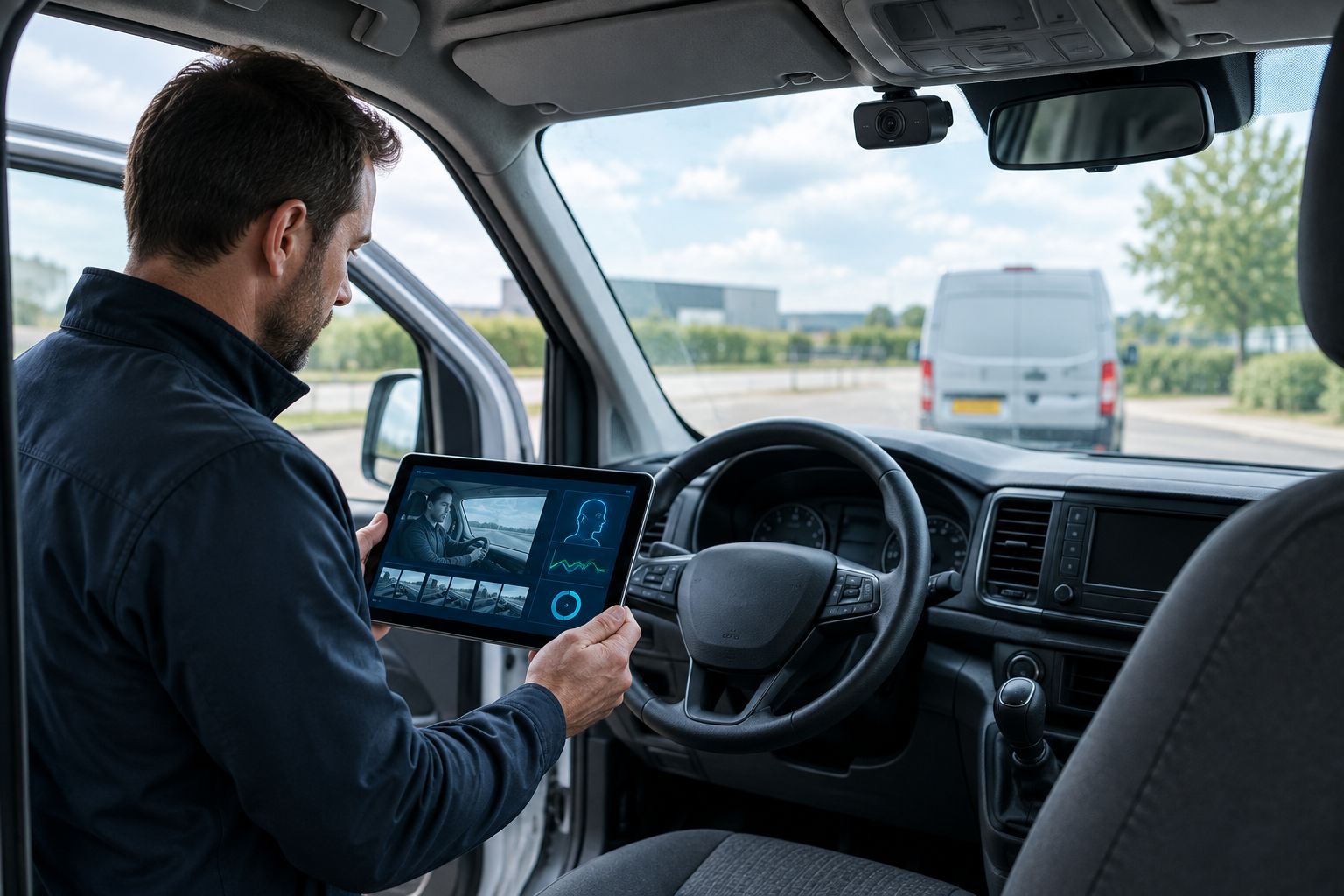
Feed behaviour data into digital vehicle checks and compliance records
Behaviour data is more useful once it sits alongside your defect and compliance records rather than in its own silo. SmartCam 4G's digital checks support this, but they support, not replace, your legal inspection and reporting duties.
- Cross-check harsh-braking patterns against reported brake or tyre defects
- Keep behaviour records alongside driver licence and CPC training records
- Use footage as supporting evidence, not a replacement, for legally required vehicle inspections
- Store review notes somewhere auditable ahead of an insurer or DVSA query
- Flag any vehicle with repeated defects and repeated harsh-event alerts for closer inspection
Comparing your options for driver behaviour monitoring
| Option | Best for | Starting price | Key limitation |
|---|---|---|---|
| SmartCam 4G | Fleets that need behaviour coaching backed by recorded video evidence | Quote-led | Footage is retrieved on demand, not streamed live |
| FleetTracker | Fleets that only need location, mileage and ADR without camera evidence | Quote-led | No camera footage or driver behaviour video evidence |
| 360° Camera System | HGVs and large vehicles needing all-round visibility beyond behaviour scoring | Quote-led | Built for surrounding visibility, not a behaviour-scoring portal |
| Manual spot checks and paper logs | Very small fleets under about five vehicles with informal supervision | No cost | Doesn't scale, no objective evidence, relies on memory |
For most SME and council fleets managing more than a handful of vehicles, SmartCam 4G is the practical choice for driver behaviour monitoring because it combines the scoring and the evidence in one place. Buy SmartCam 4G if you need coaching conversations backed by footage; stick with FleetTracker if location and mileage are your only requirement.
Common mistakes fleet managers make with driver behaviour monitoring
- Switching on every alert type on day one. This buries genuine harsh events under route-specific noise and trains managers to ignore alerts within weeks.
- Treating the Driver Score as a discipline tool first. Drivers disengage fast when a score only ever appears at a disciplinary meeting.
- Ignoring the middle of the league table. Most fleets focus coaching on the worst few drivers and miss the larger group whose small improvements would move the fleet average further.
- Confusing SmartCam 4G with the 360° Camera System when specifying a new HGV. They solve different problems: one is behaviour scoring and footage review, the other is all-round vehicle visibility.
- Letting behaviour data sit separate from defect reporting. A pattern of harsh braking on one vehicle is worth checking against its maintenance history, not just its driver's record.
If you want to see Driver Score, alerts and footage review working together on real fleet data before committing thresholds and policy, request a demo from Crystal Ball rather than guessing at settings from a spec sheet.
FAQ
What is SmartCam driver behaviour monitoring?
SmartCam driver behaviour monitoring is Crystal Ball’s video telematics feature set that scores and alerts on driving events such as harsh braking, harsh cornering and speeding, then lets you retrieve footage on demand to see what caused them. It runs through SmartCam 4G rather than as a standalone product, combining tracking data with recorded video evidence.
How does SmartCam 4G calculate a Driver Score?
SmartCam 4G’s Driver Score aggregates supported driving events, which may include harsh acceleration, harsh braking, harsh cornering, speeding and idling, into a comparable figure per driver. The exact events included depend on your current configuration, so check the live portal settings for your fleet before setting thresholds.
Does SmartCam 4G stream video live?
No, SmartCam 4G does not stream continuous live video. Footage is recorded and then retrieved on demand through the customer portal, which means reviews happen after an event rather than during it.
Can SmartCam 4G detect driver fatigue or phone use?
SmartCam 4G supports AI-based alerts for behaviours such as fatigue and distraction where currently enabled on your account. Confirm exactly which AI alerts are active for your fleet on the live Crystal Ball portal, since availability depends on your configuration.
Is SmartCam 4G better than FleetTracker for driver behaviour monitoring?
SmartCam 4G is the right choice when you need recorded video evidence behind a driving event, while FleetTracker covers location, journeys and mileage without camera footage. Fleets that only need visibility and reporting, not video evidence, are usually well served by FleetTracker alone.
Do I need a 360 degree camera system as well as SmartCam 4G?
Not for driver behaviour monitoring specifically. The 360° Camera System is built for all-round visibility on larger vehicles such as HGVs, while SmartCam 4G is the product built for behaviour scoring, alerts and footage review.
How much does SmartCam 4G cost in 2026?
SmartCam 4G is quote-led, so no fixed price is published for it. Request a quote directly from Crystal Ball for a figure based on your fleet size and vehicle mix.
Can SmartCam footage be used to dispute an insurance claim?
Recorded SmartCam footage retrieved through the portal can support a disputed claim by showing what happened before and during an incident. It works alongside your existing claims process rather than replacing it, so keep it as one part of the evidence you submit.
One last thing
The single change that moves a Driver Score fastest in 2026 isn't a new alert threshold. It's a fixed weekly slot in someone's diary to actually look at it. Fleets that review scores on the same day each week start to see the league table shift; fleets that only check after an incident don't see it move at all. Crystal Ball's SmartCam 4G gives you the data either way, but the routine around it is what turns driver behaviour monitoring into a habit rather than a report nobody reads.
Ready to see Driver Score, alerts and footage working on your own fleet? Request a Demo of Crystal Ball SmartCam 4G.
Explore the relevant Crystal Ball solution

SmartCam 4G Fleet Dash Cam
Integrated video telematics
On-demand footage, integrated tracking, incident evidence and digital vehicle checks where configured.
PRICE PROVIDED BY QUOTE
Related guides