 Get in Touch
Get a Quote

HGV fleet vehicle CCTV is camera coverage designed to help drivers see vulnerable road users around large vehicles, with the aim of supporting safer manoeuvres. In 2026, the right setup depends on the vehicle’s blind spots, the work it does and whether it needs a Greater London Direct Vision Standard (DVS) safety permit.
- Vehicle CCTV for vulnerable road users starts with a vehicle-specific blind-spot assessment, not a camera shopping list.
- Crystal Ball’s 360° Camera System is best for commercial fleets needing multi-camera visibility; it does not automatically establish DVS compliance.
- For a Greater London HGV permit, check the vehicle’s DVS rating and current TfL requirements before specifying a DVS Kit.
- Train drivers to use each view and warning, then check that cameras and other fitted equipment still work.
Why vehicle CCTV matters for HGV fleets
Cyclists, pedestrians and motorcyclists can move close to an HGV while its driver is turning, pulling away or reversing. Those movements demand different views. A rear camera cannot show someone alongside the nearside of the cab, while a nearside camera cannot show what is directly behind the vehicle.
The issue is operational as well as technical. An SME operator needs equipment its drivers can use during a busy shift. A local government fleet may need to assess several vehicle types doing different work. Both need to know what each camera shows, what it misses and who acts when a fault appears. For a closer look at the physical gaps, see how 360° camera systems address HGV blind spots.
Crystal Ball’s 360° Camera System is best for HGV fleets seeking multi-camera visibility around a commercial vehicle; operators needing a Greater London DVS permit must assess the separate permit requirements. That distinction matters in 2026: more camera views do not, by themselves, prove that every required warning or piece of equipment is fitted.
How to plan vulnerable road user visibility
Map the blind spots on each vehicle type
Start with the vehicle, not the catalogue. Park it safely and assess the driver’s view using the seat, mirrors and existing cameras as they are normally used. Have a colleague help identify areas that remain difficult to see, without putting anyone in the vehicle’s path. Repeat the assessment for materially different vehicle types rather than treating one HGV as a template for the fleet.
Record where a road user could be obscured during a left turn, when the vehicle moves off and when it reverses. Note how an attached body or load affects the view. This gives you a practical brief for a fitter and a baseline for driver training.
- Check the forward view immediately around the cab.
- Check the nearside view during a simulated left turn.
- Check the rear view from the driving position.
- Record existing mirrors, cameras and remaining gaps for each vehicle type.
Observe the manoeuvres that create the risk
A camera position is useful only if it addresses a real driving task. Review the routes, depots and stopping points used by the vehicles you are assessing. A vehicle that regularly pulls away beside a pavement needs a different review from one that mainly reverses in a controlled yard. Do this with drivers and supervisors before deciding what to fit.
Keep the assessment specific. Identify the point at which the driver needs a view or warning, and ask whether the equipment already fitted provides it without distracting from the road. A camera cannot make a manoeuvre safe if the driver has no clear procedure for responding to what it shows.
- List common turns, pull-aways and reversing tasks.
- Mark where cyclists or pedestrians can pass close to the vehicle.
- Ask drivers which existing views are hard to use during those tasks.
- Separate risks on public roads from those in depots and work sites.
Decide which views and warnings are needed
Use the assessment to write a coverage brief in plain language. Specify the area the driver needs to see and the manoeuvre involved. Avoid treating a system described as 360° coverage as proof that every camera angle suits every vehicle: mounting position and configuration still matter.
Distinguish a camera from a warning. A camera gives the driver a view to check. A proximity sensor or audible warning has a different job. If the vehicle needs a DVS safety permit, check the current Transport for London (TfL) Progressive Safe System requirements before deciding which combination to specify. In 2026, permit equipment should be assessed against the current rules, not assumed from a product category.
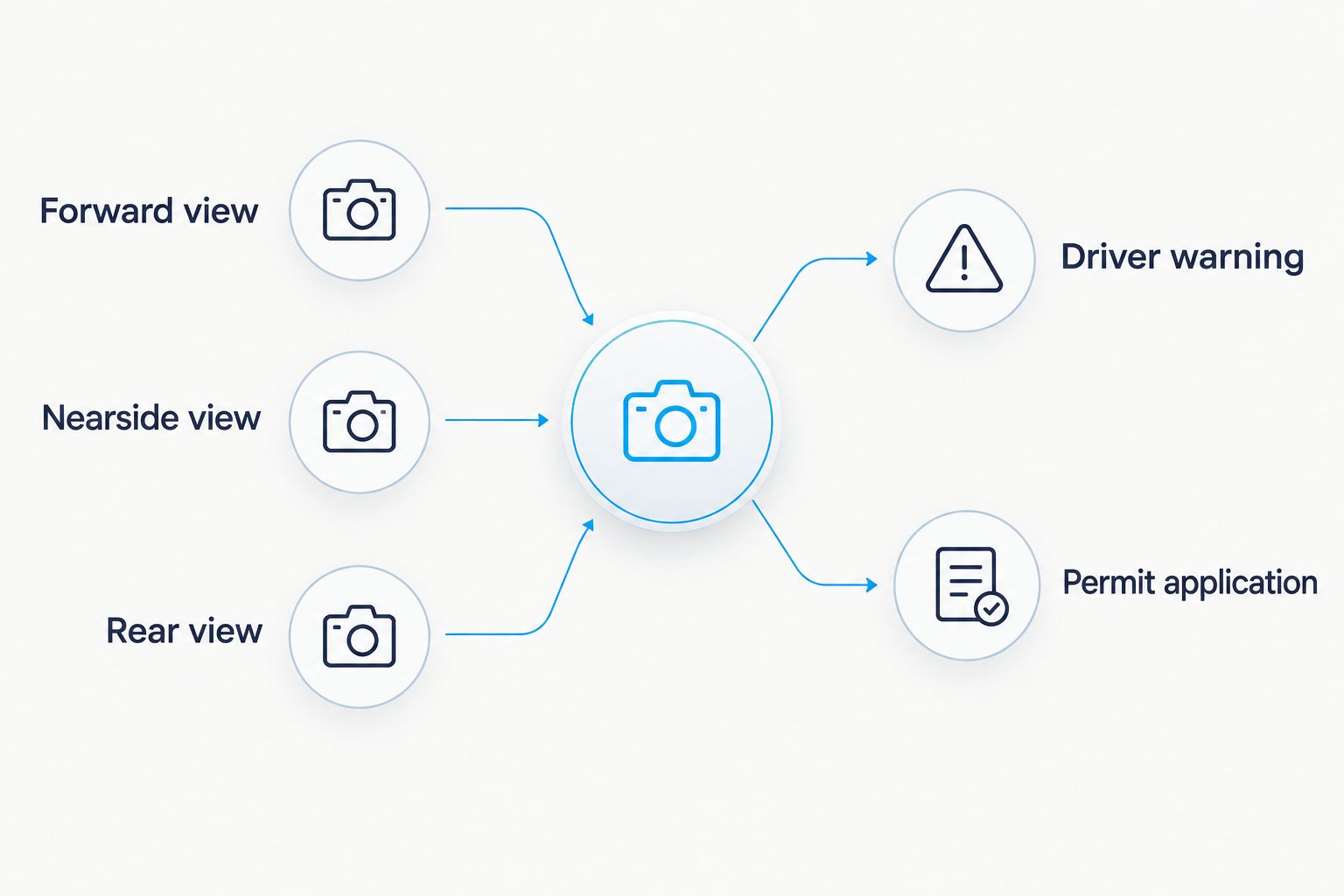
- Define the required forward, nearside and rear views.
- Identify where a driver warning is needed as well as a camera view.
- Check that the proposed in-cab display can be seen without obstructing the road view.
- Confirm which items are required for the vehicle’s permit application, if applicable.
Match the equipment to the job
Once the gaps are clear, compare solutions by function. Crystal Ball’s 360° Camera System addresses the need for configurable multi-camera commercial-vehicle visibility. It is the relevant option when a single forward-facing view leaves important areas around a larger vehicle unseen. The exact cameras and accessories must be confirmed for the selected configuration.
A different need calls for a different product. Crystal Ball’s SmartCam 4G combines tracking with recorded video telematics and footage accessed on demand through the customer portal. It suits fleets that need that connected evidence alongside tracking, but it is not a substitute for surrounding-vehicle camera coverage or a DVS equipment assessment. These are complementary tools, not interchangeable names for the same system.
- Request a configuration based on the blind-spot assessment.
- Ask which camera views are included and which are optional.
- Confirm how the driver sees each view during the relevant manoeuvre.
- Keep recorded video telematics separate from the requirement for surrounding visibility.
Check DVS requirements before fitting a London HGV
DVS is a specific Greater London HGV permit requirement, not a general label for vehicle CCTV. If a vehicle operates in Greater London, establish whether it falls within the scheme, check its star rating and determine what the current TfL rules require for that vehicle. The scheme concerns HGVs over 12 tonnes gross vehicle weight; the rating and permit position still need checking for the individual vehicle.
Crystal Ball’s DVS Kit is the relevant product when the assessment calls for Progressive Safe System equipment. Do not assume that adding a surround camera system, a dash cam or one sensor satisfies the full requirement. Confirm the complete equipment specification and the permit process against current TfL guidance before fitting. The separate guide to how the DVS HGV safety permit works explains the decision in more detail.
- Check whether each vehicle is within the DVS scheme.
- Establish its rating and current permit status.
- Compare the proposed equipment with the current TfL specification.
- Keep evidence of what was fitted with the vehicle’s permit records.
Show drivers how to use the system
Fitting a camera does not tell a driver when to look at its display. Demonstrate each view in the vehicle and explain what it covers, what remains outside the frame and what to do when visibility is poor. If warnings are fitted, distinguish the warning from the action the driver must take. A warning calls for a safe response, not an assumption that the road user has moved away.
Use familiar manoeuvres in training. A nearside view makes sense when explained at a left turn; a rear view makes sense when explained during a controlled reversing exercise. Include temporary drivers who use the vehicle, rather than assuming experience with another camera system transfers automatically.
- Identify each camera view from the driving seat.
- Practise the manoeuvres identified in the vehicle assessment.
- Explain fitted warnings and the required driver response.
- Give drivers a clear way to report a blocked lens or failed display.
Check the equipment and review what it shows
Treat camera condition as part of the vehicle’s working checks. Dirt, damage or a changed mounting position can make a fitted view less useful. Drivers should report faults promptly, while fleet managers need a process for deciding what happens to a vehicle when an important view or warning is unavailable. The equipment supports safe operation; it does not replace vehicle checks or other roadworthiness duties.
If footage is recorded, decide who needs access and why before an incident occurs. Review relevant footage after a reported near miss to understand the manoeuvre and whether the view helped. Handle footage of workers and members of the public under an appropriate data-protection process; do not invent a universal retention period for every fleet. This remains part of the 2026 operating procedure, not a task completed on installation day.
- Check that fitted views are clear and correctly aimed.
- Include lenses, displays and applicable warnings in fault reporting.
- Define who reviews footage after a reported incident or near miss.
- Review the coverage brief when a vehicle’s configuration changes.
Compare the options before you specify equipment
The best option follows the gap you found. A basic rear camera solves a narrower problem than a multi-camera setup; a DVS Kit answers a permit-led requirement that general CCTV alone cannot settle.
| Option | Best for | What it does | Key limitation |
|---|---|---|---|
| Existing mirrors and vehicle walk-around | Establishing the current view and identifying gaps | Gives the fleet a manual starting assessment | Does not add a camera view or recorded evidence |
| Rear-view camera | A vehicle with a specific reversing-view gap | Shows the area covered by its rear-facing view | Does not address the nearside or forward blind spots |
| Crystal Ball 360° Camera System | Commercial vehicles needing configurable multi-camera visibility | Provides views around the vehicle, subject to configuration | Does not automatically establish DVS compliance |
| Crystal Ball SmartCam 4G | Fleets needing tracking with recorded video telematics | Connects tracking and on-demand access to recorded footage | Does not replace a multi-camera surround setup or DVS equipment |
| Crystal Ball DVS Kit | Relevant HGVs requiring Progressive Safe System equipment | Addresses the equipment requirement identified in a DVS assessment | Permit eligibility and the complete specification still need checking |
Choose the 360° Camera System for surrounding visibility; choose the DVS Kit when the vehicle’s London permit assessment calls for it. Consider SmartCam 4G separately if tracking and recorded incident evidence are also part of the brief. Do not buy a more complex system to solve a gap that a simpler, correctly positioned camera covers.
Common mistakes HGV fleet managers make
- Specifying equipment before checking the vehicle. The same camera position does not answer every vehicle’s blind-spot assessment. Start with the view the driver actually has.
- Treating a rear camera as nearside protection. A reversing view cannot show a cyclist travelling alongside the cab at a junction. Define both tasks separately.
- Treating multi-camera CCTV as a DVS permit. A camera configuration and a Progressive Safe System assessment are different decisions. Check the rating, equipment and permit position for each relevant HGV.
- Leaving drivers to interpret alerts alone. Training must cover what a view shows and how to respond when a warning activates, not just which controls turn the system on.
- Ignoring faults after installation. A dirty lens or misaligned view can undermine the original coverage plan. Build checks and fault reporting into routine operations.
For 2026 reviews, give each vehicle type a short written coverage brief. It makes fitting discussions, driver training and later fault checks refer back to the same identified risks.
FAQ
What does vehicle CCTV for vulnerable road users do?
Vehicle CCTV helps an HGV driver see areas around the vehicle where cyclists, pedestrians or motorcyclists can be difficult to spot. The useful camera views depend on the vehicle and the manoeuvres it performs.
Is a reversing camera enough for vulnerable road user visibility?
No, a rear-facing camera addresses a rear-view gap, not a nearside or forward blind spot. Assess each position separately before deciding what coverage the vehicle needs.
Does a 360° camera system make an HGV DVS compliant?
No, a 360° camera system does not automatically establish DVS compliance. Check the vehicle’s rating, permit status and current TfL equipment requirements separately.
When should an HGV operator consider a DVS Kit?
Consider a DVS Kit when a Greater London HGV assessment shows that Progressive Safe System equipment is required. Confirm the vehicle’s position and the current specification before fitting.
Is SmartCam 4G the same as a surround camera system?
No, Crystal Ball SmartCam 4G provides tracking and recorded video telematics with footage accessed on demand. Surrounding-vehicle visibility calls for a separately specified multi-camera system.
How should drivers use vehicle CCTV?
Drivers should know which view covers each manoeuvre and how to respond to fitted warnings. Training should also show them how to report an unclear view or equipment fault.
How long should a fleet keep vehicle CCTV footage?
There is no single retention period that suits every fleet recording. Set a documented period based on the purpose of recording and check the current ICO guidance for handling personal data.
One last thing
A camera specification is only as useful as the view on the day the vehicle goes to work. Before accepting a fitted system, sit in the driving seat and check the forward, nearside and rear views against the gaps recorded at the start. If a view does not show the area it was bought to cover, correct the configuration before treating the assessment as complete. That simple acceptance check gives your 2026 training and maintenance process something specific to protect.
To have camera coverage specified and priced against the blind spots on your own vehicles, Request a Quote.
Explore the relevant Crystal Ball solution

Crystal Ball 360° Camera System
Multi-camera commercial-vehicle CCTV configured around the vehicle to support surrounding visibility and recorded incident evidence.
Related guides
- Side camera coverage for commercial vehicles
- Commercial vehicle CCTV maintenance checklist
- DVS compliance audit checklist